
Items in the cart:
Cart is empty
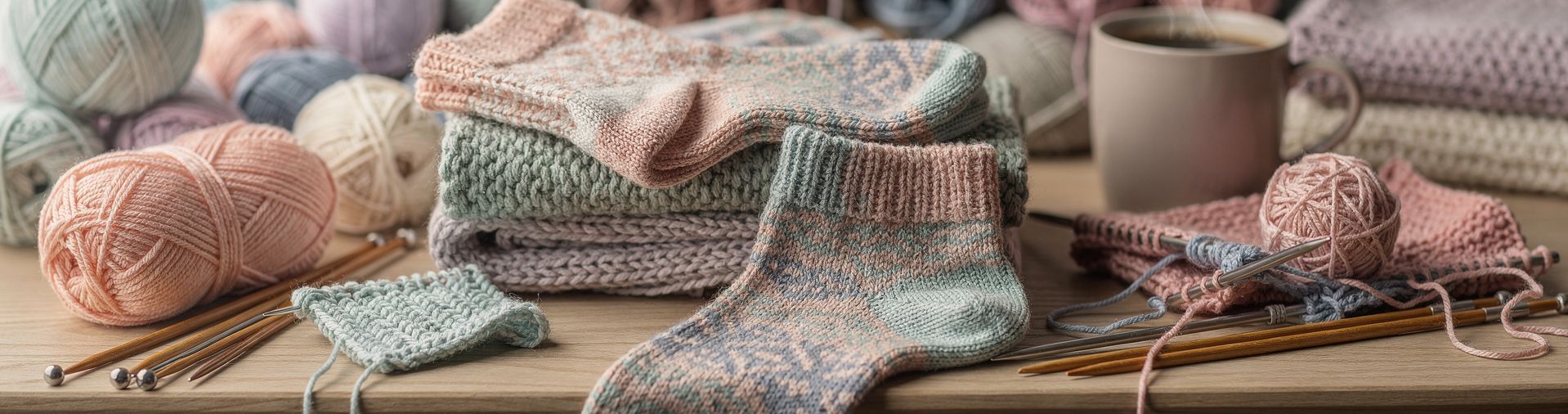
In Germany, there is a standard, a study — and at least ten types of socks for almost every problem. The selection of “warm” socks is correspondingly impressive. However, many models, especially so-called “cozy socks,” are predominantly made of polyester and polyamide.
These synthetic materials, when produced using classic machine knitting techniques (rib knit, jersey knit), generate hardly any real warmth: they merely increase the volume of the fabric — that is, the feeling of warmth — without providing significant insulation.
Hand-knitted wool socks with a wool content of approximately 50–70%, on the other hand, demonstrate measurably higher thermal efficiency. The reason lies not in marketing, but in the physical properties of wool and the structural characteristics of hand knitting techniques (wool.com).
Fiber structure and air chambers
Wool has a complex, crimped fiber structure: the fibers are scaly and spirally twisted. This structure enables the formation of air pockets, which serve as the primary insulating material — since air conducts heat significantly worse than solid materials (mdpi.com).
In other words: it is not the sock that warms — but the air it intelligently traps.
Hygroscopicity and thermoregulation
Wool can absorb up to 30% of its own weight in moisture without losing its insulating properties. During this process, heat is released through adsorption, creating a stable microclimate between the skin and the sock (mdpi.com, wool.com).
The result: feet stay warm — even when they technically shouldn’t.
Synthetic fibers vs. natural fibers
Synthetic fibers (polyester, polyamide, acrylic) have significantly lower adsorption heat (~5–7 J/g) compared to wool (~100–115 J/g). This means synthetic materials cannot create a lasting thermal balance in the way wool can (mdpi.com).
Comparison of the adsorption heat of wool, polyester, and cotton as the basis of thermoregulatory properties.
In short: plastic can look warm — but it cannot think warm.
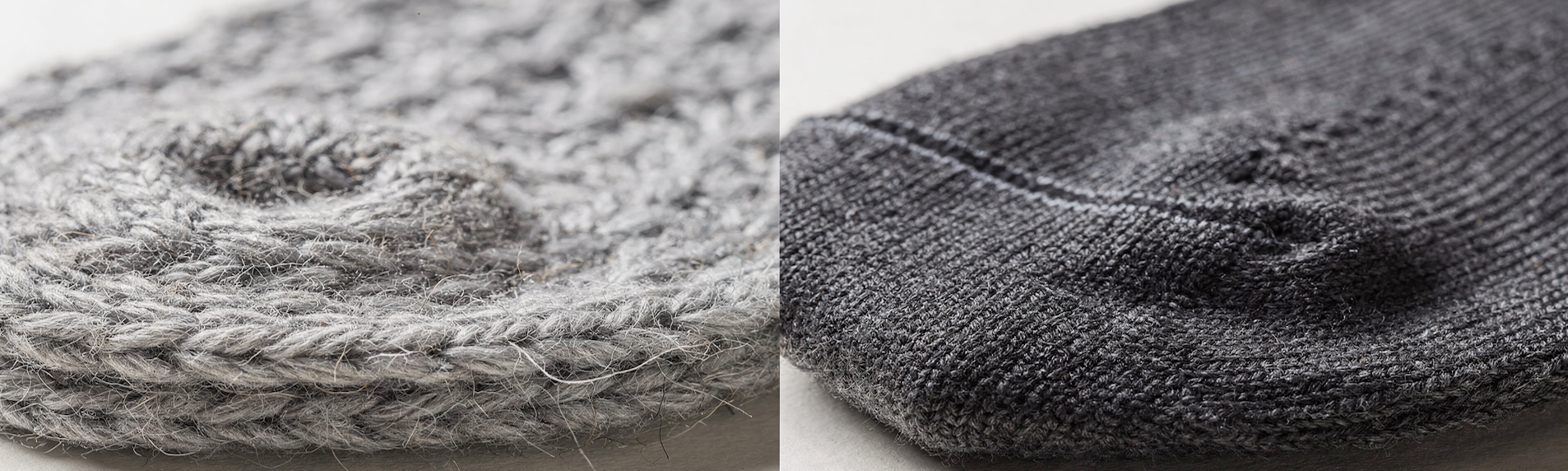
Hand knitting
Machine knitting
Structural difference between hand-knitted wool and machine-knitted synthetic socks: air pockets vs. dense layer and heat conduction.
Result: Synthetic “cozy” socks often look warmer but provide significantly less warmth (wool.com).
Or put differently: they are fluffy — but physically disappointing.
These physical differences can be described not only qualitatively, but also demonstrated through measurement.
Graphical representation
Chart: Comparison of thermal conductivity (W/m·K) – Hand-knitted wool socks vs. industrially knitted socks vs. synthetic socks
The lower the thermal conductivity (W/m·K), the better the insulation.
The graphic clearly shows that hand-knitted wool socks have significantly lower thermal conductivity than industrial or synthetic models.
Wool percentage alone is not a measure of warmth
| Type of sock | Wool content | Technique | Thermal effect |
| Thin merino | 70–80 % | Machine knitting | Cool (too thin, little air) |
| Thermal socks | 30–40 % | Volume/air chamber technique | Very warm (thick, loose, lots of air) |
| Hand-knitted wool socks | 50–70 % | Hand knitting, controlled stitch density and twisting | Very warm, durable, insulating |
Interpretation: Structure, stitch density, and air chambers determine warmth — not wool content alone. Synthetics without special techniques generate hardly any warmth (mdpi.com).
Problems with 100% wool socks or socks with little wool
Scientific conclusion
Hand-knitted socks with a wool content of approximately 50–70% combine:
Result: A level of warmth that commercially available synthetic socks generally cannot achieve.
Conclusion for buyers
Hand-knitted wool socks are not just soft. They are the result of precise material architecture, physical principles, and craftsmanship.
If you are truly looking for warm socks, you should pay attention to two things:
that they are hand-knitted – and that the wool content is at least 50%, ideally between 50% and 70%.
Because real warmth is no coincidence. It is the result of good physics.
● Is silk in wool yarn beneficial? You can find the answers in the article Wool yarn with silk.