Why hand-knitted socks (50–55% wool) outperform industrial socks: A market analysis.
This analysis examines the structural shortcomings of the German sock market and explains why conventional industrial products often fail to meet thermal requirements.
Key findings of the analysis:
- Market gap: Over 80% of the mass market is based on cotton and synthetics—materials that physically provide little insulating performance (warmth).
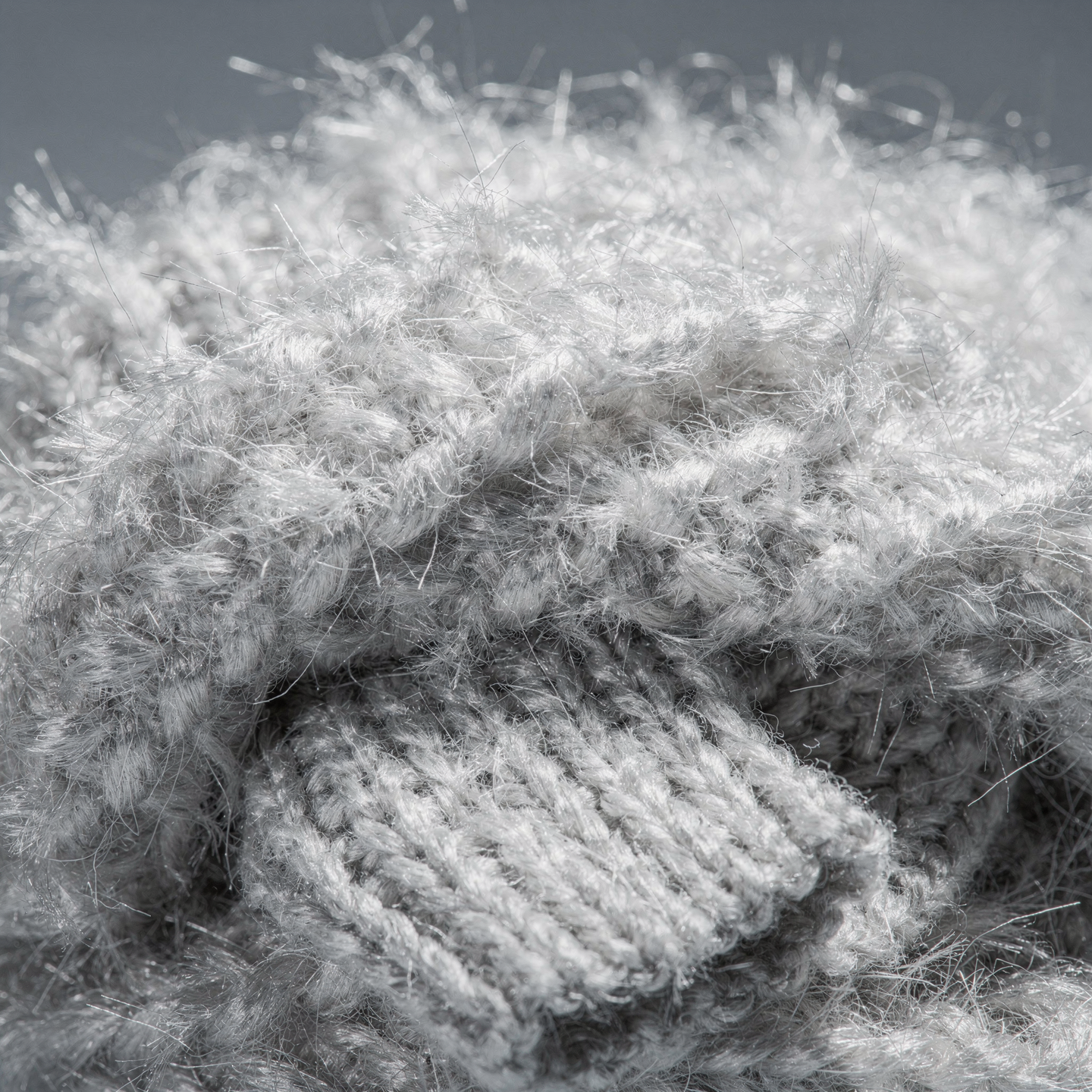
- Structural paradox: Industrial “cozy socks” simulate warmth through surface fluff, but due to low air volumes in the stitch structure, they offer no lasting insulation.
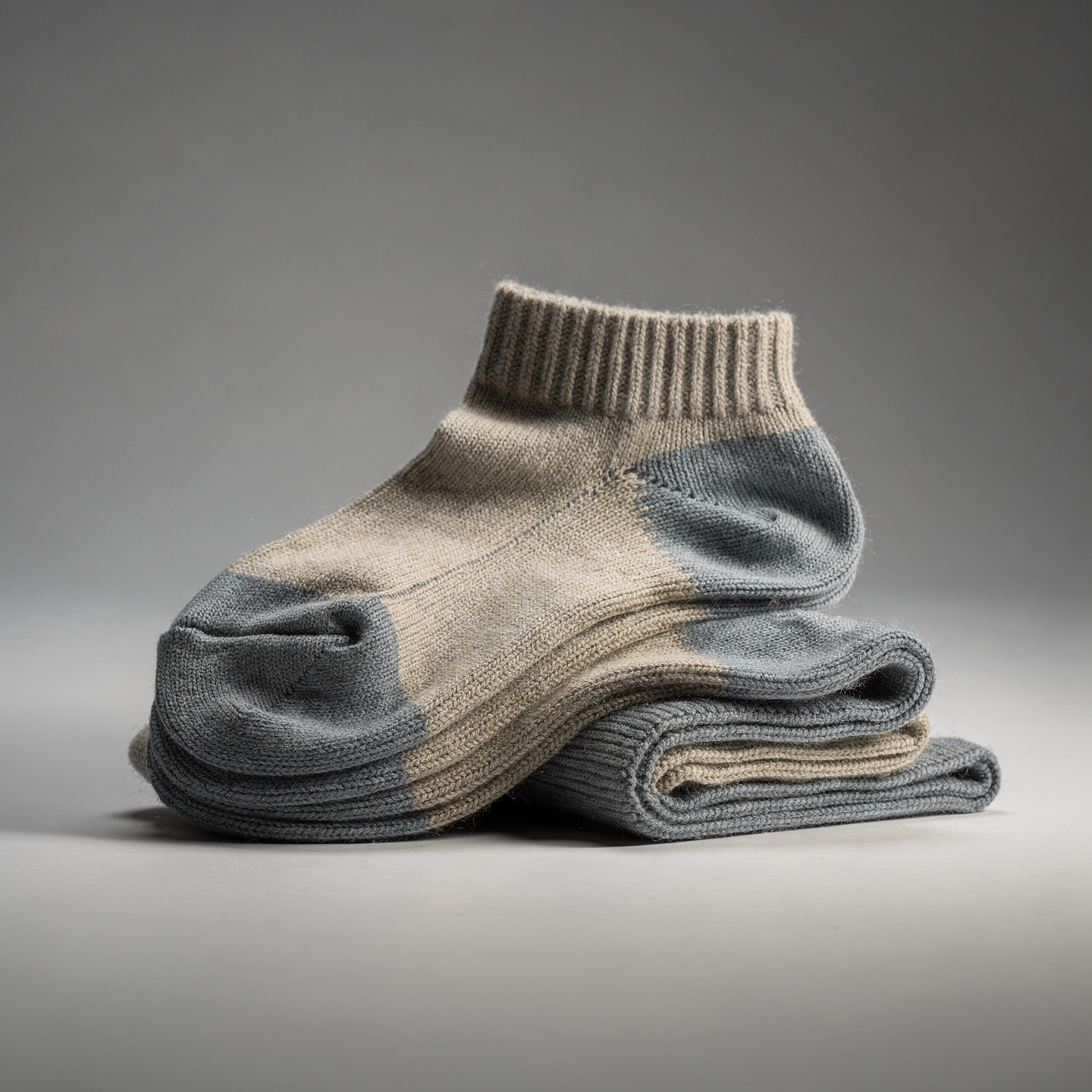
- The functional optimum: Hand-knitted socks with a composition of 50–55% wool represent the technological optimum. They combine the heat of adsorption of the natural fiber with the mechanical stability of synthetic fibers.
- Craft as precision: Only the variable, three-dimensional structure of handwork creates the necessary air pockets that wool needs for true thermoregulation.
Conclusion: True warmth is not the result of wool content alone, but an interplay of material physics and construction.
1. Market analysis: typical compositions in Germany
1.1 Low price segment (mass market)
Typical composition of warm socks in the low-price segment in Germany:
1.1 Low price segment (mass market)
Typical composition of warm socks in the low-price segment in Germany:
Cotton: 50–80%
→ high comfort, but low warmth performance
Polyester / polyamide / acrylic: 20–45%
→ durability, volume, cost efficiency
Elastane: 1–5%
→ elasticity and fit
Wool: 0–10%
→ thermally barely relevant
Key takeaway:
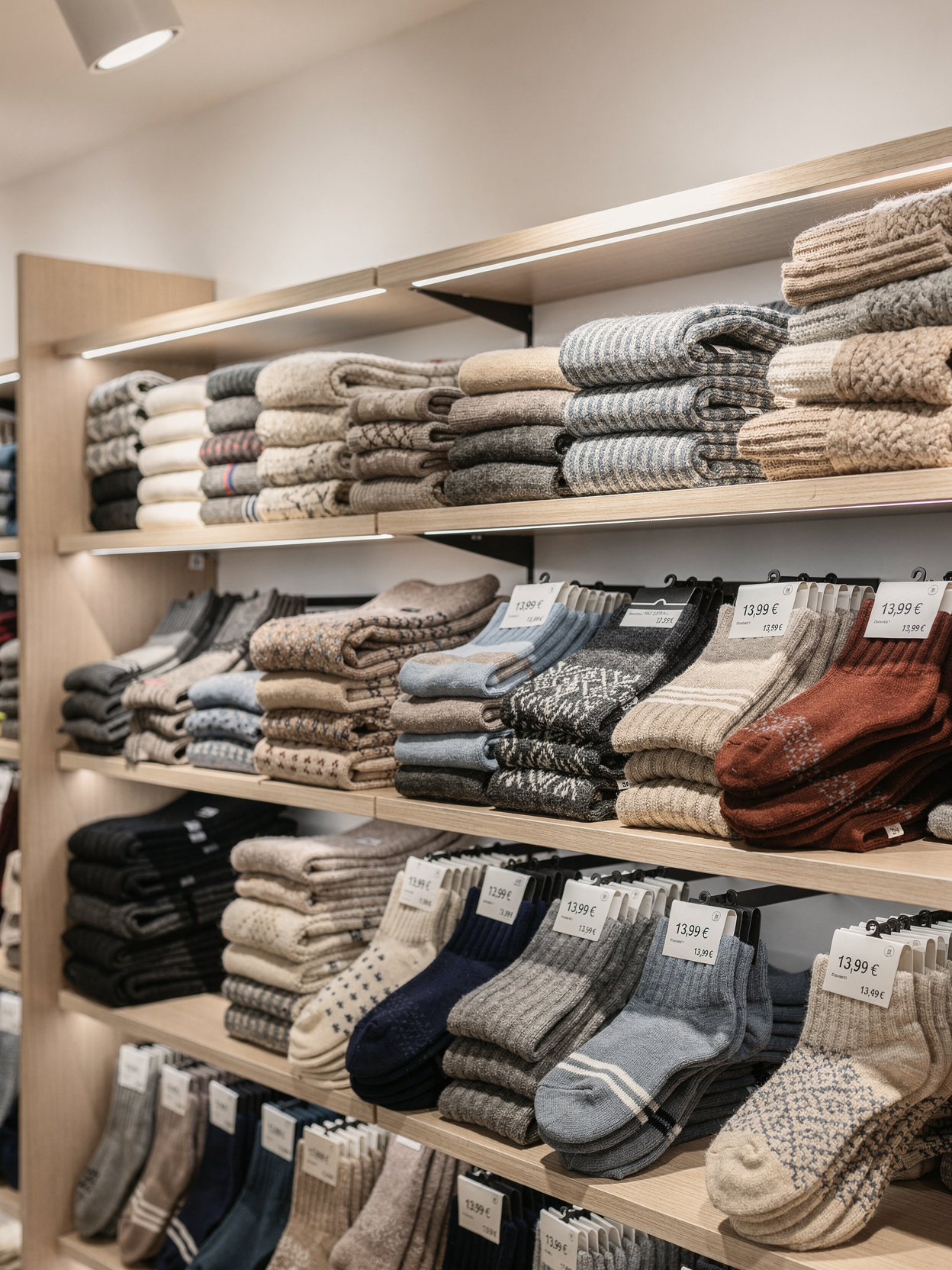
In the mass market, cotton and synthetic fibers dominate, even though they provide only limited insulation in physical terms.
1.2 Mid-range segment (“winter” and “thermal” socks)
Typical composition of socks in the mid-price segment:
Wool (mostly merino): 30–60%
→ basic thermal function
Polyamide / polyester / acrylic: 30–55%
→ mechanical stability and cost control
Elastane: 2–5%
→ shape retention
Key takeaway:
Wool is present, but its effect is limited by industrial knit structures and high synthetic content.
1.3 Higher segment and outdoor/premium products
Typical composition of premium and outdoor socks:
Wool: 60–80%
→ high thermal performance
Polyamide: 15–35%
→ abrasion resistance and durability
Elastane: 2–5%
→ ergonomic fit
Key takeaway:
These products are significantly more expensive and make up only a small share of the German sock market.
Key takeaway:
In the mass market, cotton and synthetic fibers dominate, even though they provide only limited insulation in physical terms.
1.2 Mid-range segment (“winter” and “thermal” socks)
Typical composition of socks in the mid-price segment:
- Wool (mostly merino): 30–60%
→ basic thermal function - Polyamide / polyester / acrylic: 30–55%
→ mechanical stability and cost control - Elastane: 2–5%
→ shape retention
Key takeaway:
Wool is present, but its effect is limited by industrial knit structures and high synthetic content.
1.3 Higher segment and outdoor/premium products
Typical composition of premium and outdoor socks:
- Wool: 60–80%
→ high thermal performance - Polyamide: 15–35%
→ abrasion resistance and durability - Elastane: 2–5%
→ ergonomic fit
Key takeaway:
These products are significantly more expensive and make up only a small share of the German sock market.
1.4 Summary market logic
The German market follows a clear structure:
- Cotton + synthetics = mass-market standard
- Wool = an add-on, not the norm
- 50–65% wool = an industrial compromise
- true warmth = a rare byproduct, not the goal of production
The market optimizes not warmth, but efficiency.
2. Wool: a functional material, not just a natural product
Wool is not a romantic natural material, but a physically highly complex system.
Thermoregulation instead of mere insulation
- crimped fiber structure → stable air pockets,
- moisture absorption up to ~30% → release of adsorption heat,
- dynamic microclimate between skin and textile.
Cotton cannot do this. Synthetics cannot do this.
3. Why synthetic fibers are still indispensable
The idea that 100% wool is ideal is technically incorrect.
Mechanical reality:
Pure wool:
- wears out faster,
- loses shape stability,
- felts,
- compresses air volume → loss of thermal performance.
Synthetic fibers serve a functional role:
- increase abrasion resistance (heel, toe),
- stabilize the stitch structure,
- extend service life,
- prevent structural densification.
Synthetics are not the opposite of quality—they are part of a functional architecture.
4. The decisive difference: industrial vs. hand-knitted structure
Industrial socks are optimized for:
Industrial socks are optimized for
• production speed,
• homogeneous stitch structure,
• minimal material variation.
Physically, that means
• low air volumes,
• flat textile structure,
• limited thermal performance.
Hand-knitted socks follow a different logic
• variable stitch density,
• three-dimensional structure,
• stable air chambers,
• living fiber architecture.
Industrial socks are optimized for:
- production speed,
- homogeneous stitch structure,
- minimal material variation.
Physically, that means:
- low air volumes,
- flat textile structure,
- limited thermal performance.
Hand-knitted socks follow a different logic:
- variable stitch density,
- three-dimensional structure,
- stable air chambers,
- living fiber architecture.
This is where wool unfolds its true function.
5. Why 50–55% wool is the functional optimum range
In hand-knitted socks, around 50–55% wool creates a balance:
- enough wool for true thermoregulation,
- enough synthetic fibers for stability,
- maximum preservation of air volume.
More wool does not automatically mean more warmth. Less wool almost always means less function.
Industry uses similar percentages—but only in the hand-knitted structure do they become effective.
6. The illusion of “coziness”
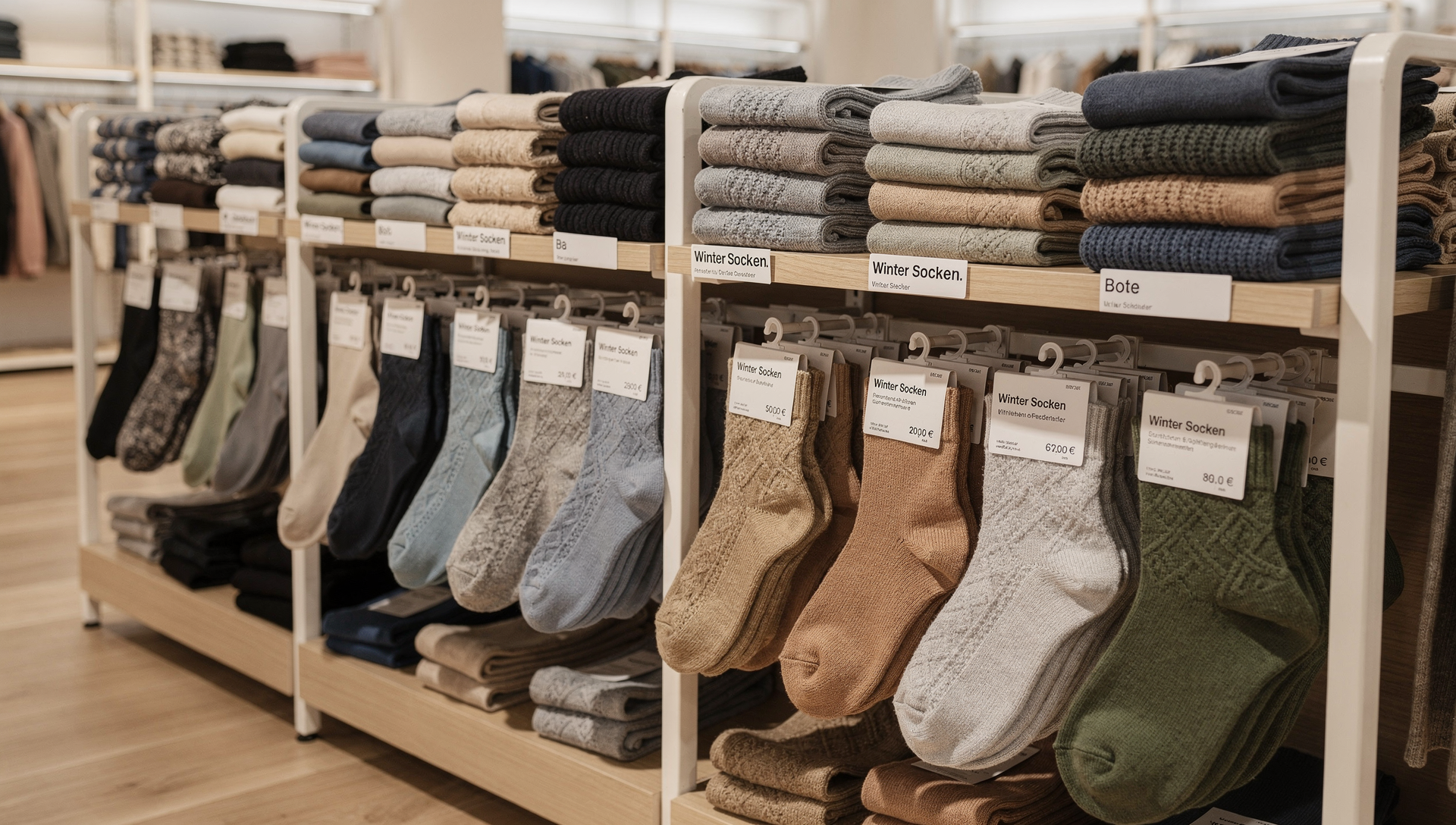
In German retail, so-called cozy socks dominate, whose composition is often determined by polyester and polyamide.
Fluff creates a feeling of warmth. But feeling is not physics.
Fluff is surface. Warmth is structure.
Conclusion
The industrial sock is optimized for price and scalability. The hand-knitted sock is optimized for function and purpose.
Hand-knitted socks with 50–55% wool are:
- warmer than most industrial products,
- more stable than pure wool socks,
- more functional than synthetic solutions,
- more durable than mass-market goods.
This is not more wool. This is a different logic of the material.
And that is exactly why handwork today is not a nostalgic craft, but a form of technological precision in the premium segment.
Experience the difference: physics instead of promises. If you are tired of cold feet despite a “cozy look,” invest in real thermal efficiency. Our hand-knitted socks use the physical optimum of 50–55% wool and a living stitch structure for maximum thermal insulation.
● Fast fashion – slow catastrophe. Find out how the material of your clothing affects our planet’s environment...